How to Choose a Ball Bearing: Types, Loads and Rating Life
By Constantine Zhan · 14 August 2026
A ball bearing rarely fails because someone picked the wrong brand. It fails because the load was misjudged, the fit was wrong, or the wrong sub-type was fitted for the alignment the machine actually has.
This guide covers the four ball bearing families you will meet in a catalogue, the rating life equation that decides the size, and the fits and failure modes that decide whether it reaches that life.
What a Ball Bearing Does
Rolling Contact Instead of Sliding
A ball bearing carries load through a small number of hardened balls that roll between two rings. Rolling contact replaces sliding contact, and friction drops sharply as a result. Nothing else in the drivetrain gives up so little energy.
That is the whole trade. A ball touches the raceway over a tiny area, so friction is low, and the contact stress in that tiny area is very high.
- Low friction: rolling rather than dragging.
- High contact stress: the price of a small contact patch.
- Hardened steel: the only way to survive that stress. - Contact stress is why bearing steel is so tightly specified. - It is also why contamination does so much damage.
The Four Parts
Every ball bearing has the same four components, whatever the label on the box. Inner ring, outer ring, balls and cage.
The cage carries no load at all, and simply keeps the balls evenly spaced so they never touch each other.
- Inner ring: fits the shaft, usually the rotating member.
- Outer ring: fits the housing bore.
- Balls: the rolling elements that carry the load.
- Cage: spaces the balls, carries nothing.
Ball Bearing Types That Cover Most Jobs
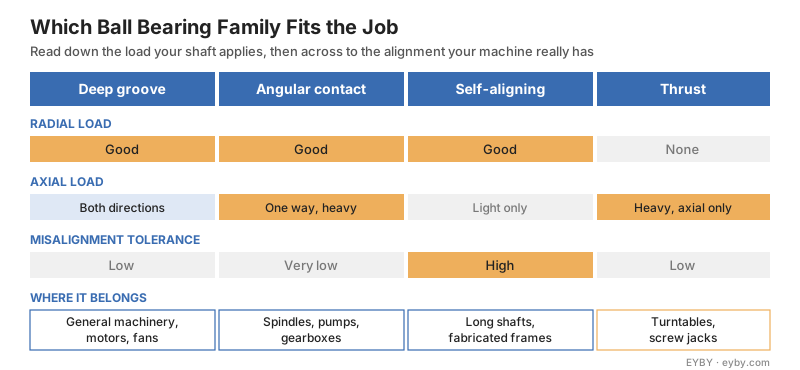
Deep Groove
The deep groove ball bearing is the default. Bearing makers call it the most widely used bearing type and a very versatile one. It has low friction, runs quietly, and reaches high running speeds.
It also takes radial load and axial load in both directions, mounts easily and needs less maintenance than most alternatives. That combination is why it dominates catalogues.
Two variants extend it, because filling-slot designs pack in more balls for a higher radial rating and double row designs add a second ball row when capacity runs short.
Angular Contact
An angular contact ball bearing runs its contact line at an angle to the bearing axis, which lets it carry heavy axial load. A single row design takes that axial load in one direction only.
Because of that, single row angular contact bearings are normally adjusted against a second bearing facing the other way. The rings are non-separable, with an upper and a lower shoulder. Machine tool spindles and pump shafts use them because the pair can be preloaded, which removes play.
Self-Aligning
A self-aligning ball bearing has two rows of balls running in a sphered raceway in the outer ring. The inner ring keeps two deep uninterrupted grooves. That geometry makes the bearing shrug off angular misalignment between shaft and housing, including the misalignment caused by shaft deflection under load.
Long shafts, fabricated frames and field-assembled equipment are the natural home for it.
Thrust
A thrust ball bearing is built for axial load and very little else. Balls run between two washer-like rings rather than inside a groove in a shaft-mounted ring. Use it where a shaft pushes rather than spins fast, such as turntables, screw jacks and low-speed vertical shafts.
| Type | Radial load | Axial load | Misalignment | Typical use |
|---|---|---|---|---|
| Deep groove | Good | Both directions | Low | General machinery, motors |
| Angular contact | Good | One direction, heavy | Very low | Spindles, pumps, gearboxes |
| Self-aligning | Good | Light | High | Long shafts, fabricated frames |
| Thrust | None | Heavy, axial only | Low | Turntables, screw jacks |
Load Ratings and Rating Life
Dynamic and Static Ratings
Two numbers appear on every ball bearing data sheet. The basic dynamic load rating, written as C, feeds the life sum for a rotating bearing. The equivalent load, written as P, is the single figure that combines the real radial and axial forces acting on that bearing.
- C: the catalogue capacity of the bearing.
- P: the real load your machine applies.
- The ratio: everything that follows depends on C divided by P.
The L10 Equation
Rating life is a statistical idea, not a warranty. It is the fatigue life that a defined percentage of identical bearings, running in identical conditions, is expected to reach or exceed.
The industry settles on ninety percent. The life that 90 percent of a large group of identical bearings will attain is called L10. It is measured in millions of turns, or in running hours as L10h.
ISO 281 gives the basic rating life as L10 equal to the ratio of C to P raised to the power p. Gustav Lundberg and Arvid Palmgren developed the model between the 1920s and the 1940s.
Why the Exponent Rules Everything
For ball bearings the exponent p is 3, while roller bearings use 10/3. A cube is a brutal multiplier, and it is the single most useful fact in bearing selection.
Halve the load and the life goes up eightfold, while a small rise in load costs far more life than it looks.
| C divided by P | Rating life, million revolutions |
|---|---|
| 2 | 8 |
| 3 | 27 |
| 4 | 64 |
| 5 | 125 |
| 6 | 216 |
| 8 | 512 |
| 10 | 1,000 |
- Cheapest life gain: reduce the load, not the price.
- Cheapest life loss: an unplanned belt tension or a misalignment.
- Model limits: the load-based equation assumes perfect alignment. - It also assumes a 180 degree load zone and no moment loads. - Stress-based models such as ISO 16281 drop those assumptions.
Fits, Mounting and Clearance
Which Ring Gets the Tight Fit
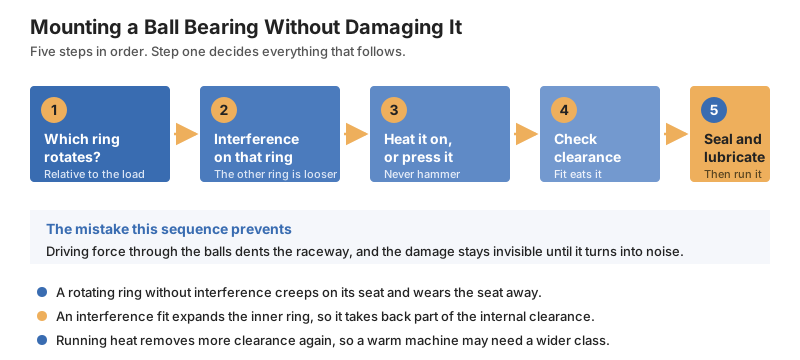
The ring that rotates relative to the load direction needs an interference fit. Without it that ring creeps on its seat, and creep wears the seat until nothing sits true.
In most machines the inner ring rotates, so the shaft seat carries the interference and the housing bore is looser.
- Rotating ring: interference fit, no exceptions.
- Stationary ring: a looser fit, so it can be mounted.
- Creep: the symptom of getting this backwards.
Mounting Without Wrecking the Raceways
Never drive mounting force through the balls. Press on the ring being fitted, and only on that ring. Force through the ball path dents the raceway.
A bearing heater is the clean way to fit an interference ring on a shaft, because controlled growth slides it on with no press force at all.
- Press on the fitted ring: never through the rolling elements.
- Heat, do not hammer: a bearing heater beats a mallet every time.
- Keep it clean: dirt fitted today is a failure next quarter. - Brinelling from impact shows as evenly spaced marks. - The damage is invisible until it becomes noise.
Internal Clearance
Internal clearance is the free movement inside an unmounted ball bearing. It matters because an interference fit expands the inner ring and eats some of that clearance.
Heat does the same thing again once the machine runs. Where the temperature difference across the bearing is large, a wider clearance class buys the margin back.
Sealing and Lubrication
Open, Shielded or Sealed
The same ball bearing is usually sold three ways. Open, shielded with a metal disc, or sealed with a contact lip.
Choose by setting and speed rather than by price, because contact seals keep out the most dirt and cost the most friction.
- Open: relies entirely on the housing to keep dirt out.
- Shielded: a non-contact gap, low friction, moderate protection.
- Sealed: rubbing lip, best exclusion, highest drag.
Grease or Oil
Most ball bearings run on grease, because grease stays where it is put and helps seal the bearing. Sealed bearings arrive greased for life and are never refilled.
Oil earns its place at high speed or high temperature, where it also carries heat away. That advantage arrives with a circulation system attached.
- Grease: simple, sealed, adequate for most machinery.
- Oil: high speed and high temperature duty.
- Over-greasing: churns, heats and does real harm.
Compare the radial ball bearings, the angular contact ball bearings and the self-aligning ball bearings side by side before you commit to a sub-type.
How Ball Bearings Actually Fail
The Six ISO Failure Modes
ISO 15243 sorts bearing damage into six principal groups by what the damage looks like. Rolling contact fatigue, wear, corrosion, electrical erosion, plastic deformation, and cracking and fracture.
Naming the mode is what points at the cause, because a polished raceway tells a different story from a pitted one.
- Rolling contact fatigue: the mode the L10 life predicts.
- Wear and corrosion: lubrication and sealing problems.
- Electrical erosion: stray shaft current, common on drives.
What Turns Up in Practice
Failure survey data is more useful than the theory here. One published SKF study found abrasive wear at 26 percent, surface initiated fatigue at 16 percent, moisture corrosion at 14 percent, adhesive wear at 7 percent and current leakage erosion at 7 percent.
Those five modes covered roughly 70 percent of everything identified in the survey.
Classic subsurface fatigue, the failure the rating life equation predicts, is not the one filling the workshop bench. Contamination, moisture and electricity are.
- Keep it clean: abrasive wear leads the table by a wide margin.
- Keep it dry: moisture corrosion is next.
- Ground the shaft: current leakage erosion is preventable.
Frequently Asked Questions About Ball Bearings
What is the most common type of ball bearing?
The deep groove ball bearing. Bearing makers describe it as the most widely used bearing type and a very versatile one. It handles radial load and axial load in both directions, runs at high speed, and is easy to mount.
How do I calculate ball bearing life?
Use the ISO 281 basic rating life, where L10 is the ratio of the basic dynamic load rating C to the equivalent load P, raised to the power p. For a ball bearing p is 3, so the result is that ratio cubed, in millions of revolutions.
What does L10 mean on a bearing?
It is the rating life that 90 percent of a large group of identical bearings, running under identical conditions, is expected to reach or exceed. It is quoted in millions of turns, or as L10h in running hours. One bearing in ten is expected to fall short.
Which ring of a ball bearing should be a tight fit?
The ring that rotates relative to the load direction. In most machinery the inner ring rotates, so the shaft seat takes the interference fit and the housing bore is looser, otherwise the ring creeps and wears its seat.
Why do ball bearings fail before their calculated life?
Usually because something outside the equation reached them first. A published SKF study puts abrasive wear, surface initiated fatigue, moisture corrosion, adhesive wear and current leakage erosion together at roughly 70 percent of the failure modes it identified.
Conclusion
Choose a ball bearing in three moves. Match the sub-type to the load direction and the alignment, work out the ratio of C to P, then cube it to see whether the rating life clears the service interval.
Deep groove for general duty, angular contact where axial load leads, self-aligning where the shaft moves, thrust where the load is purely axial.
After that the machine decides. Fit the right ring tight, heat rather than hammer it on, keep dirt and water out, and a correctly sized ball bearing will get near the life the equation promised, alongside the ball thrust bearings that handle what it cannot.
Related Posts
Sandblasting Sand: Why the Cheapest Abrasive Costs You the Most

Types of Pliers: Jaw Shapes, Grip and What Each Pair Is For