
Car Ramps: How to Match Weight Rating and Approach Angle to Your Vehicle
By Jackie Guo · 12 September 2026
Two car ramps sit on a shop floor. They look identical, and one of them will not hold the van parked outside.
Car ramps are the cheapest way to get a vehicle off the ground, which is exactly why they get bought carelessly. The rating on the box and the angle of the slope decide whether the purchase works. Neither is obvious from a photograph.
This guide covers both numbers, the materials underneath them, and the safe way to drive up.
What Car Ramps Are For
A ramp lifts one axle by having the vehicle climb it. There is no hydraulics, no pump, and no failure mode involving a dropped seal.
Where They Beat a Jack
Speed is the honest answer. An oil change on ramps takes a minute of setup rather than four separate lifts. Nothing has to be pumped, positioned or double-checked.
Car ramps also spread load across a wide footprint instead of one small pad.
Where They Fall Short
You cannot remove a wheel on a ramp. Anything involving brakes, hubs or suspension needs a jack and a stand instead.
Car ramps only serve jobs that leave the wheels on:
- Oil and filter changes on a warm engine.
- Exhaust and underbody inspection.
- Transmission and differential fluid service.
- Undertray removal and skid-plate access.
The Governing Standard
Automotive ramps have their own section of ASME PASE-2019, the Safety Standard for Portable Automotive Service Equipment. Part 7 of that American National Standard covers them. Ramps sit alongside jacks, stands and shop cranes in the same document.
The standard treats equipment as portable when it is not fixed in one location and can be moved between workplaces. It sets performance, safety, marking, testing and load-rating requirements across the whole family, from hydraulic jacks and automotive stands through to shop cranes and oil-filter crushers.
That marking requirement is why rated car ramps carry their capacity on the product itself.
Weight Rating: The Number You Cannot Guess
Every pair of car ramps carries a capacity figure. Car and Driver's tested guide is blunt about it: you absolutely should not exceed this number. Each corner going up has to sit under the ramp maximum.
Reading the Rating Correctly
The figure quoted is usually for the pair, not for one ramp. That distinction is where most sizing mistakes begin.
- Per pair is the total the two ramps carry together.
- Per ramp is half of that, and it is the number your axle has to fit under. - A pair rated at 6,000 pounds is a 3,000-pound ramp. - Never read the pair figure as a per-corner allowance.
- Check the label before you compare two products on price.
Finding Your Vehicle's Weight
Gross vehicle weight rating sits on a placard, usually in the driver's-side doorjamb. It covers the vehicle plus the maximum cargo allowed, so it already carries a margin.
Gross axle weight rating is the more useful figure for car ramps, because only one axle climbs.
The Arithmetic That Matters
Car and Driver sets out the calculation directly. Take the gross axle weight rating for the axle you are lifting, then divide by two. That gives the per-ramp load.
Their worked example: a vehicle with a 5,000-pound front GAWR needs ramps rated for at least 2,500 pounds each, or 5,000 per pair.
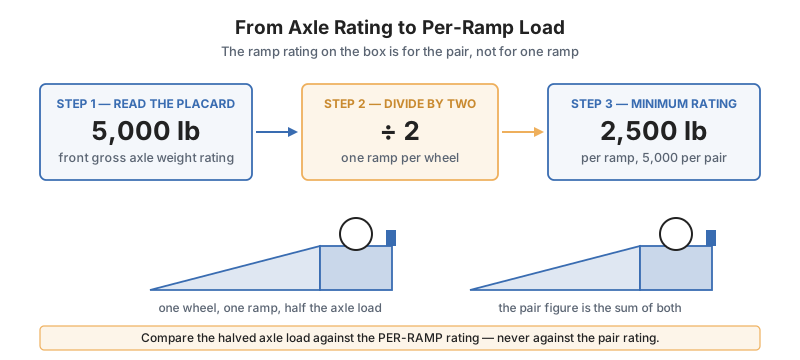
- Read the front GAWR from the doorjamb placard.
- Halve it to get the load on each ramp. - Do this for the rear axle too if you ever lift the back. - Fleet vehicles often carry a higher rear GAWR than front.
- Compare that against the per-ramp rating, not the pair rating.
- Leave headroom for a loaded vehicle, roof racks and towing gear.
Approach Angle and Ground Clearance for Car Ramps
The second number stops the bumper before the tyre arrives. It is the one buyers skip.
Why the Angle Decides the Purchase
A steep ramp meets a low nose long before the tyre reaches the slope. Splitters, air dams and long front overhangs all make the problem worse.
Car and Driver rate approach angle as one of their core test criteria, alongside weight rating, ramp height, ramp weight, storage, slipping and stability.
What Low-Profile Car Ramps Buy You
Length is what buys a gentle angle. The Race Ramps RR-56 that Car and Driver tested shows the trade clearly:
- Length: 56 inches, which is what creates the shallow slope.
- Approach angle: 10.8 degrees, low enough for aggressive front splitters.
- Height cleared: 6.5 inches, which their Volkswagen GTI managed easily.
- Weight: roughly 10 pounds per ramp.
The trade is storage. A ramp that long is awkward to put away, which is why some models split into two pieces.
Measuring Your Own Clearance
There is a workshop method that needs no calculator. Push a yardstick under the front of the front tyres. Raise it until it touches the nose or underbody of the car.
The angle you have just made is roughly the steepest ramp the vehicle will accept. Measuring the sides of that triangle and applying the Law of Cosines gives the exact figure if you want it.
| Selection factor | What to check | Why it matters |
|---|---|---|
| Per-ramp rating | Half the axle GAWR | Stops an overload on one side |
| Approach angle | Degrees at the initial rise | Prevents nose and splitter contact |
| Ramp height | Working clearance gained | Sets whether you fit underneath |
| Ramp length | Storage footprint | Long ramps buy angle, cost space |
| Tyre width | Ramp channel width | A narrow ramp lets a tyre drift off |
| Surface grip | Anti-slip texture or coating | Stops the ramp walking on smooth floors |
Materials and Surface Grip
Car ramps come in steel, resin and moulded plastic. Each behaves differently on a shop floor.
Steel
Steel takes the heaviest ratings and the roughest handling. It is also heavy to move. On sealed concrete it can slide.
Powder coating helps corrosion resistance but does nothing for grip.
Resin and Plastic
Moulded ramps are light enough to carry one-handed. They resist oil and salt. They will not rust in an outdoor yard.
Their limit is capacity and heat, so keep them away from exhaust runs and hot tarmac.
Anti-Slip Matters More Than Material
Car and Driver's buying advice is explicit that car ramps need some form of anti-slip technology. Two failure modes are in play here.
- The ramp can slide forward across the floor as the tyre climbs. - Sealed and painted concrete makes this far more likely.
- The tyre can spin on the ramp face instead of gripping.
- A rubber pad or textured underside addresses the first problem.
- A moulded tread pattern on the ramp face addresses the second.
Car Ramps Versus Stands and Jacks
These tools are not substitutes. They cover different jobs, and mixing them up is how people get hurt.
| Task | Ramps | Jack and stands |
|---|---|---|
| Oil and filter change | Yes | Workable but slower |
| Exhaust and underbody inspection | Yes | Yes |
| Wheel or brake work | No | Yes |
| Suspension work | No | Yes |
| Setup time | Under a minute | Several minutes |
| Floor space needed | Run-up length | Working area only |
The Rule That Does Not Bend
A vehicle held only by a lifting device is not a vehicle you get under. OSHA's rule for shop jacks makes the principle plain. The operator must make sure the jack has a rating sufficient to lift and sustain the load, and the base must be blocked where the foundation is not firm.
Car ramps sidestep part of that risk because nothing is holding pressure. The vehicle rests on its own tyres.
When to Combine Them
Front on car ramps and rear on stands is a common fleet setup for long underbody jobs. It gives a level working height without a lift.
Chock the wheels that stay on the ground either way.
Safe Use of Car Ramps in a Working Bay
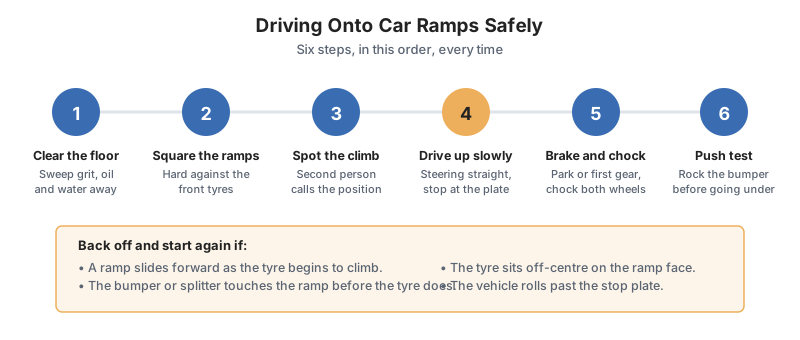
Most incidents with car ramps are procedural, not mechanical. Someone rushes the climb, or skips the chocks. A fixed sequence removes both.
Before the Drive-Up
- Square the car ramps to the tyres and set them on clean, dry floor.
- Sweep away grit, oil and water under the ramp feet.
- Use a spotter to call the tyre position as the vehicle moves.
During the Climb
Drive up slowly and stop when the tyre reaches the flat. Sudden throttle is what pushes ramps out from under a car.
- Keep steering straight throughout the climb.
- Stop at the stop plate, not past it. - Rolling off the end damages the ramp and the vehicle. - Reversing off and starting again costs nothing.
After the Vehicle Is Up
- Apply the parking brake and select park or first gear.
- Chock both wheels still on the floor. - Chock ahead of and behind each tyre on a sloped bay.
- Push the front bumper firmly to confirm nothing moves.
- Only then get underneath.
Inspection and Retirement
Check car ramps the way you would check any rated tool. OSHA requires jacks that are out of order to be tagged and withdrawn until repaired, and the same discipline suits car ramps.
- Look for cracks around the load-bearing ribs.
- Check that anti-slip pads are still bonded.
- Retire any car ramps with a permanent bend or a missing stop plate.
Browse vehicle loading and repair ramps for rated pairs, vehicle stands for the jobs ramps cannot cover, and wheel chocks to hold the axle that stays down.
Frequently Asked Questions About Car Ramps
How much weight can car ramps hold?
It depends entirely on the model. The rating is printed on the product, so compare the per-ramp figure against half your axle's gross axle weight rating.
Are car ramps safer than jack stands?
They are different tools. Car ramps hold nothing under pressure, which removes one failure mode. They cannot be used for wheel or brake work, so neither one replaces the other.
What approach angle do I need for a lowered car?
Measure it rather than guess. Push a yardstick under the front tyres and lift it until it meets the bodywork, and that angle is the steepest ramp the car will accept.
Do I still need to chock the wheels?
Yes. Apply the parking brake and select park or first gear. Then chock both wheels that remain on the floor.
Are plastic car ramps strong enough?
For most passenger cars, yes. Check the rating against your axle load, and keep resin ramps away from hot exhaust components and hot tarmac.
Is there a standard covering car ramps?
Yes. Part 7 of ASME PASE-2019 covers automotive ramps, and the wider standard sets performance, marking, testing and load-rating requirements across jacks, stands, dollies and shop cranes.
Conclusion: Buying Car Ramps That Fit the Fleet
Two numbers do almost all the work. Halve the axle rating to get the per-ramp load, and measure the approach angle with a yardstick before you shop.
Everything after that is preference: steel or resin, one piece or two, stored on a shelf or against a wall.
Get the rating and the angle right and car ramps become the fastest tool in the bay. Get either one wrong and they become an expensive pair of doorstops.
Related Posts