Types of Pliers: Jaw Shapes, Grip and What Each Pair Is For
By Dmitry Shevlenko · 18 August 2026
Most tool belts carry one or two pairs of pliers, and they are usually whatever came in the starter kit. That is a problem, because pliers are one of the most specialised hand tool families there is. Pick the wrong pair and the job gets harder or the work gets damaged.
This guide walks the main types, the jaw and joint details that separate them, and the rating you must check before any pair goes near a live panel.
What Pliers Actually Do
Every pair of pliers is a lever with jaws on the end. The joint sets how far the jaws open, and the jaw shape sets what the tool can hold.
Grip, Cut, Bend or Hold
Four functions cover almost everything a plier is asked to do, and most pairs are strong at one or two of them.
- Grip — hold a fastener, pipe or wire while you turn or pull it.
- Cut — shear wire, cable or small fasteners cleanly.
- Bend — form a loop, hook or right angle in wire and sheet.
- Hold — clamp onto work and stay there without hand pressure.
A pair that claims all four is a compromise on each. That is fine for a service call and wrong for repeat production work.
Joint Type Sets the Jaw Range
The joint is the quiet specification that decides whether a pair fits your work at all.
- Fixed pivot — one jaw range, best precision, used on cutters and long nose designs.
- Slip joint — two positions, so one pair covers small and medium work.
- Tongue and groove — many positions along a toothed channel, for wide jaw range.
- Toggle link — locks under load, so the grip holds without your hand.
The Main Types of Pliers
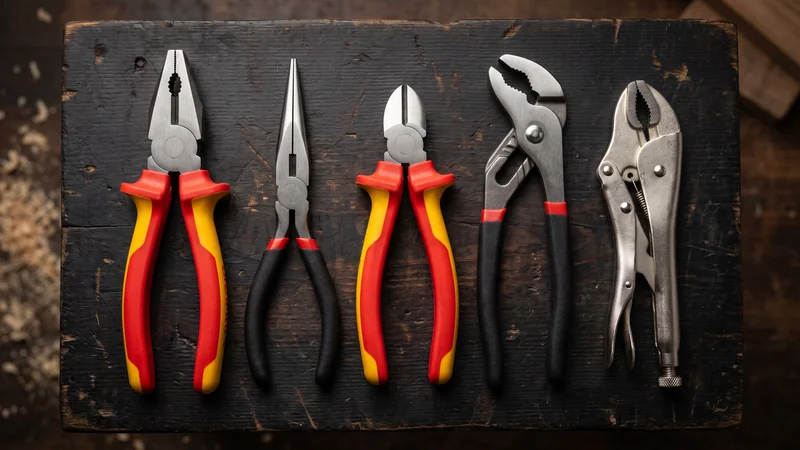
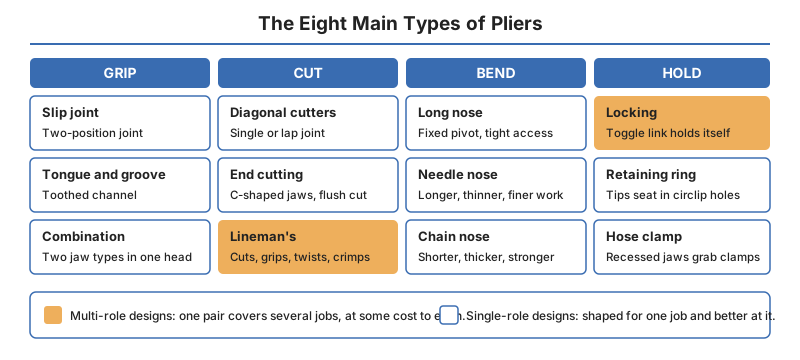
MSC Direct groups the field into diagonal, lineman's, long nose, slip joint, groove joint, end cutting, locking and specialty designs. Those eight cover the vast majority of trade work.
Slip Joint Pliers
The pivot slides between two positions, one for smaller work and one for larger. A serrated jaw handles gripping, bending and light fastening.
They are the catch-all rather than the specialist, and standard sizes run 6, 8 and 10 inches, with the 8-inch the usual general-purpose choice.
Tongue and Groove Pliers
Often called channel lock or water pump pliers, these slide the lower jaw along a toothed channel across many positions. That delivers a wide jaw range without sacrificing grip strength.
Plumbers and HVAC technicians reach for them first, because they hold pipe, fittings, nuts and bolts that defeat a standard pair. Some carry V-notch jaws that grip a fastener the way a wrench does. The angled head also stops your hand slipping when the fitting finally moves.
Sizes run from about 6.5 inches to 16 inches. A 9-inch is the everyday pair and a 12-inch handles the larger work.
Lineman's Pliers
Also called side-cutting pliers, these are the electrician's workhorse. One pair cuts, grips, twists and crimps. The heavy head and short jaw give the leverage needed to twist solid conductors together without the tool flexing.
Long Nose and Needle Nose Pliers
Long nose designs reach into confined spaces to grip and bend small components. Many incorporate cutting jaws or stripper holes for small-diameter wire.
- Serrated jaws — maximum grip, at the cost of marking the workpiece.
- Smooth jaws — protect plated, polished or delicate material.
- Bent noses — 45 or 90 degree heads that reach around an obstruction. - Chain nose pairs are shorter and thicker for extra strength. - Needle nose pairs are longer and thinner for finer work.
Cutting Pliers in Detail
Cutters look interchangeable on a shelf and behave very differently in the hand. Three specifications explain the difference.
Joint Style
Diagonal cutters are built for cutting alone, and they come in two joint styles.
- Single joint — smaller, for precision work on electronics and fine wire.
- Lap joint — larger, for heavy-duty cutting. - The single joint uses a pocket-and-protrusion design that keeps the cutting edges aligned. - The lap joint places a high-leverage pivot close to the edges, so the cut takes less handle force.
Cut Style
The cut style decides how clean the cut end is and how much shock travels into the work.
| Cut style | Best for | What you get |
|---|---|---|
| Standard | General cutting | Fastest work, some tip pinch |
| Semi-flush | Most applications | Less shock, less tip pinch |
| Flush | Delicate work | Clean end that aids soldering |
Flush cutting matters more than it sounds, because a clean end helps solder wet properly, and that is what makes the finished connection reliable.
Head Shape
Head shape is a trade between access and tool life.
- Oval head — the most versatile, with the most material behind the edges, so it lasts longest.
- Tapered head — reaches confined spots, with less head mass and proportionally fewer cuts.
End Cutting Pliers
Also known as pincers or nippers, these carry C-shaped jaws for flush cuts. The rounded head doubles as a pry for nails and tacks, much like a claw hammer.
Holding and Specialty Pliers
Some applications need the tool to stay clamped after your hand lets go, and some need a jaw shape nothing else provides.
Locking Pliers
Locking pairs use a toggle-link mechanism with an adjustable pivot that sets the clamping force. Once closed they hold on their own. Jaw configurations cover welding, plumbing and woodworking, so the family is far wider than the classic curved-jaw pair.
Retaining Ring Pliers
Snap ring or retaining ring pairs carry tips that seat in the holes of internal and external circlips. The wrong tip size slips and launches the ring, which is why these come in sets rather than singles.
Hose Clamp Pliers
These are a modified slip joint design with recesses cut into the jaws. The recesses capture wire spring tension clamps that a normal jaw simply pushes off.
Combination Pliers
Combination pairs do the same jobs as a lineman's pair but run thinner, and the head carries two different gripping jaw types. They suit general maintenance applications where one pair has to cover a lot of ground.
Insulated and Non-Sparking Pliers
Two ratings change the tool from a preference into a requirement, and neither is a marketing label.
The 1000 V Rating
IEC 60900 is the international standard for insulated hand tools, and ASTM F1505 is its North American counterpart.
- Rated working voltage — 1,000 V AC and 1,500 V DC.
- Proof test — 10,000 V AC applied for three minutes, a tenfold margin.
- Marking — the voltage stamped on the tool plus the double-triangle symbol.
- Test scope — dielectric strength, impact, insulation adhesion and heat resistance. - Adhesion testing confirms the coating stays bonded to the steel underneath. - Thermal testing checks the insulation holds up in heat and in cold.
Lineman's, needle nose and diagonal patterns all appear in the covered list, usually in 6, 8 and 9 inch sizes for work in live panels and junction boxes.
Inspection Before Every Use
The standard expects damage to be visible, which only helps if somebody looks.
- Check for cracks, cuts or wear in the insulation before each use.
- Remove a damaged pair from service immediately rather than finishing the shift with it.
- Never rework insulation with tape or heat shrink, because the rating dies with the original coating.
Non-Sparking Pliers
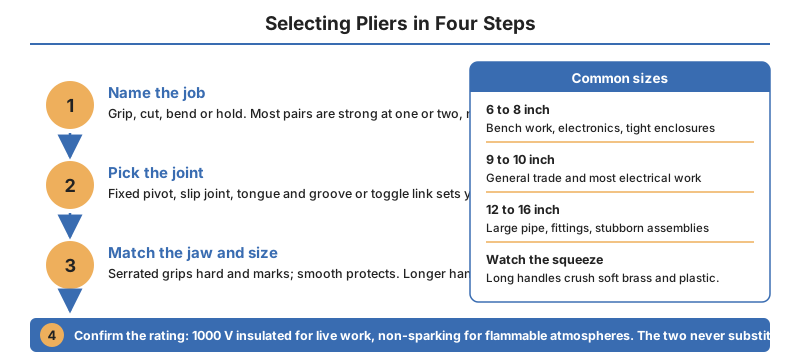
Non-sparking versions exist for atmospheres where a stray spark is the hazard. They are a separate purchase from insulated pliers and the two ratings do not substitute for each other.
What OSHA Expects
OSHA puts the duty on the employer, not the toolbox owner. The rule states that each employer is responsible for the safe condition of tools and equipment used by employees, including tools employees supply themselves.
That last clause catches a lot of sites out. A worn personal pair on a job site is still the employer's problem. Inspection records need to cover the whole belt, not just the store issue.
Choosing and Sizing a Pair
Size changes leverage, reach and how much damage a careless squeeze can do.
Match Size to Leverage
Longer handles mean more clamping force at the jaw. That is welcome on a seized fitting and dangerous on a plastic one.
- 6 to 8 inch — bench work, electronics and confined enclosures.
- 9 to 10 inch — general trade work and most electrical applications.
- 12 to 16 inch — large pipe, fittings and stubborn assemblies.
Watch the Overtightening Risk
The mechanical advantage that breaks a stuck fitting loose also crushes soft brass and plastic. Control the squeeze rather than trusting the tool to stop you.
Build a Set, Not a Pile
- Start with three — a lineman's pair, a long nose pair and a tongue and groove pair.
- Add by trade — retaining ring sets for machinery, hose clamp pairs for vehicles.
- Buy insulated separately — a general-purpose pair never becomes a live-working pair.
Frequently Asked Questions
What are the main types of pliers?
The main categories are diagonal, lineman's, long nose, slip joint, groove joint, end cutting, locking and specialty designs. Each one is shaped for a different mix of gripping, cutting, bending and holding.
What is the difference between needle nose and chain nose pliers?
Chain nose pairs are shorter and thicker, which makes them stronger, while needle nose pairs run longer and thinner for finer work in tight spaces.
Are channel lock and water pump pliers the same thing?
They are close cousins rather than twins. Tongue and groove pairs use interlocking grooves, while water pump versions use serrated teeth or scallops aligned by a pin or gear.
What does the 1000 V marking on pliers mean?
It means the pair is rated for live work up to 1,000 V AC and 1,500 V DC under IEC 60900. Each tool is proof tested at 10,000 V AC for three minutes before it earns the mark.
Can I use insulated pliers in an explosive atmosphere?
No, because those are different ratings: insulated pairs guard against shock, while non-sparking ones are made to avoid igniting a flammable atmosphere.
What size pliers should I buy first?
An 8-inch slip joint pair and a 9-inch lineman's pair cover most everyday work. Add a 12-inch tongue and groove pair once you start meeting larger pipe and fittings.
Conclusion
Choosing pliers is really three decisions. Identify the application first, then select the joint that delivers the jaw range you need, then confirm whether the site demands an insulation or non-sparking rating.
Get those three right and the rest is sizing: short handles for control and reach, long handles for force, and a deliberate hand on anything soft.
The tool that damages the work is almost never faulty. It is usually the wrong pair, used because it was the only one on the belt.
Browse pliers to compare jaw shapes and joint types across the range. For clamping work, see locking pliers sets. For electrical work, lineman's pliers come in general-purpose, insulated and non-sparking versions.
Related Posts
Sandblasting Sand: Why the Cheapest Abrasive Costs You the Most