
Caster Wheels: How to Specify Load, Material and Brakes
By Jan Hoffmeier · 10 August 2026
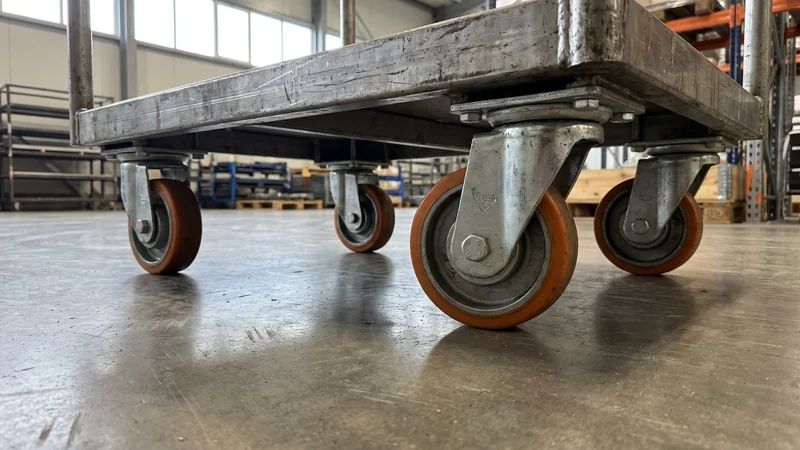
Nobody buys a trolley for its wheels. Everybody notices them the day a loaded cart refuses to turn. Caster wheels are the cheapest part of the machine and the one part that decides whether it moves.
Get the rating wrong and the caster wheels flat-spot inside a month. Get the material wrong and the floor pays for it. This guide sets out the numbers a buyer actually needs, and where those numbers come from.
Every figure below traces to the caster industry's own standard or to a manufacturer's published data.
What Caster Wheels Have to Do
Four Jobs at Once
Caster wheels carry weight, roll, steer and, usually, stop. Those four demands pull against each other. The Institute of Caster and Wheel Manufacturers, an industry group within MHI, writes the ANSI-ICWM standard that defines how each one is tested.
That standard is the reason a rating means anything at all.
The Vocabulary That Trips Buyers Up
A caster is the whole assembly. Caster wheels are only the round parts that touch the floor.
- Caster: wheel plus rig, mount and any brake.
- Rig: the fork and, on swivel units, the raceway that lets it turn.
- Mount: how the caster fixes to the equipment. - Plate, stem, bolt-hole or side-mount. - Not interchangeable without redrilling.
Swivel Versus Rigid
Most equipment mixes both kinds of caster wheels. Two rigid units give a straight line, two swivel units give the turn.
- Four swivel: full manoeuvrability, poor tracking down a long aisle.
- Two and two: the workshop default for trolleys and racks.
- Swivel with lock: a swivel unit that can be pinned straight when needed. - Engage the lock with the wheel trailing, as ICWM recommends. - Locking against a turned wheel loads the pin sideways.
Load Rating Is the Number That Decides Everything
One Caster, Not the Cart
A load rating applies to a single caster, never to the equipment as a whole. The total to be carried is the empty weight of the trolley plus the heaviest payload it will ever hold.
Divide that total across the caster wheels fitted, and the arithmetic looks easy. It is not, because floors are never flat.
The Three-of-Four Rule
Engineers and equipment designers commonly assume only three of the four casters carry the load at any moment. Uneven floors and shifting loads take the fourth out of contact. Sizing on three rather than four builds in the margin that keeps caster wheels alive.
| Total load, trolley plus payload (kg) | Total load (lb) | Minimum rating per caster (kg) | Minimum rating per caster (lb) |
|---|---|---|---|
| 300 | 660 | 100 | 220 |
| 500 | 1,100 | 167 | 370 |
| 750 | 1,650 | 250 | 550 |
| 1,000 | 2,200 | 334 | 735 |
| 1,500 | 3,300 | 500 | 1,100 |
| 2,000 | 4,400 | 667 | 1,470 |
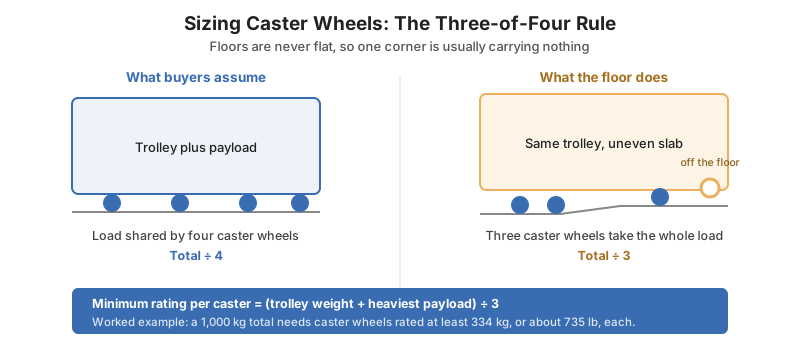
Ask how the rating was established before trusting it. ICWM ratings come from testing a fully loaded caster over its projected service life, both stationary and in motion.
Signs the Rating Was Too Low
Under-rated caster wheels announce themselves long before they fail outright.
- Flat spots: the wheel has been parked loaded too long or is simply overloaded.
- Hard steering: the swivel raceway is taking more than it was built for.
- Early bearing failure: the classic symptom of a caster sized on price.
- Wobble and noise: usually swivel play opening up under load. - ICWM measures that play before and after the dynamic test. - Excess play hurts both ergonomics and operator safety.
Caster Wheel Materials Compared
The Three That Cover Most Jobs
Caster wheels are graded first on tread material, which sets load capacity, rolling resistance and how the floor survives. Diameter and bearing type do the rest.
| Wheel material | Load capacity | Rolling resistance | Floor protection | Best fit |
|---|---|---|---|---|
| Polyurethane | Excellent | Lower | Excellent, non-marking grades exist | General industrial and food service |
| Rubber, pneumatic | Good, roughly 300 to 7,000 lb | Higher | Fair | Rough ground and delicate loads |
| Steel or cast iron | Highest | Not published | Poor, and noisy on concrete | Extremely heavy duty and high heat |
Why Polyurethane Dominates
Polyurethane combines the grip and shock absorption of rubber with the wear resistance and load capacity of hard plastic. It also resists chemicals, oils and salts. Caster Concepts rates it above pneumatic caster wheels on wear, load capacity, floor marking and rolling resistance.
Food service leans on it because it is non-marking and non-staining.
Where Polyurethane Struggles
The same source is candid about the limits.
- Heat: lower heat resistance than metal, so it can deform.
- Flat-spotting: left loaded and stationary, it takes a set.
- High speed: rolling resistance climbs and wear follows.
When Pneumatic Wins
Air-filled rubber caster wheels beat polyurethane on traction and cushioning. That matters outdoors and on broken concrete.
- Rough ground: shock absorption protects the load and the frame.
- Delicate cargo: instruments, glass and electronics ride better.
- Yard use: kerbs and expansion joints stop being obstacles.
Diameter Beats Cleverness
Bigger caster wheels are the simplest upgrade available. Larger diameters roll more easily, clear obstacles better and spread weight more effectively. If a cart is hard to push, try the next diameter up before anything else.
Mounting Styles and Where They Belong
Plate, Stem, Bolt-Hole and Side
The mount decides whether replacement caster wheels drop straight in.
- Plate mount: four bolts through a top plate, the industrial standard.
- Stem: a single threaded or grip-neck post into a tube or socket.
- Bolt-hole: one central bolt through the rig.
- Side mount: the rig bolts to a vertical face where height is tight. - Useful under low decks and inside frames. - Check swing clearance before ordering.
Matching the Replacement
Swapping caster wheels on existing equipment is a measuring job, not a shopping one.
- Bolt pattern: measure hole centres both ways, not the plate edge.
- Overall height: mixing heights tips the deck and unloads a corner.
- Swivel radius: the offset that lets the wheel trail behind the pivot.
Brakes and Locks Do Less Than You Think
What a Brake Is For
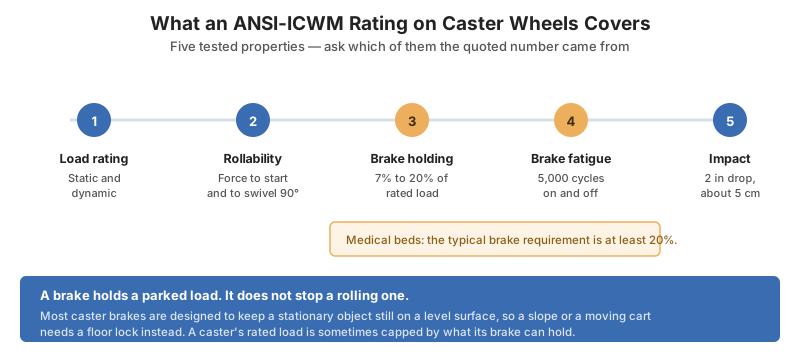
Most caster brakes are designed to keep a stationary object still on a level surface. They are not designed to slow or stop something already moving.
That single sentence from ICWM prevents most brake complaints.
The Numbers Behind the Lever
Brake performance on caster wheels is specified, not assumed.
- Holding force: a minimum of 7 to 20 percent of rated load, by brake type.
- Medical beds: the typical requirement is at least 20 percent.
- Capacity cap: a caster's rated load is sometimes limited by its brake.
- Fatigue: ICWM cycles brakes on and off at least 5,000 times. - Performance can fade long before the wheel wears out. - Conforming products must still work after normal use.
Total Lock and Floor Locks
A total lock stops the wheel and the swivel together. A floor lock is a separate foot that pushes down onto the ground.
Pick the floor lock when equipment on caster wheels must not creep at all.
- Wheel brake: holds the tread, leaves the swivel free.
- Total lock: pins tread and swivel in one movement.
- Floor lock: a separate foot pressed down onto the ground. - Best on sloped or vibrating floors. - Adds height, so check the deck clearance.
Rollability, Ergonomics and Impact
How Rollability Is Measured
ICWM defines rollability as two forces: the force to start the load rolling, and the force to swivel the caster through 90 degrees.
Both are testable numbers, so both can be compared between suppliers.
- Starting force: what the operator feels on the first shove.
- Swivel force: what it takes to turn the unit through a right angle.
- Ask for both: a catalogue that quotes neither is quoting nothing.
Why It Is a Safety Issue
Excessive push and pull forces cause back and shoulder injuries, downtime and workers' compensation claims. Caster wheels are an ergonomics decision as much as a hardware one.
- Diameter: the largest lever on push force.
- Wheel material: the tread compound is the second lever after diameter.
- Bearings: precision units cut both starting and rolling force.
Impact and Static Charge
Caster wheels get hit. Forklifts, pallet jacks and kerbs all deliver blows the rig has to absorb.
ICWM tests vertical impact strength by dropping the caster from 2 inches, which is about 5 centimetres. Conductive grades are tested separately, with minimum resistance values separating conductive, static-dissipative and insulating products.
- Impact drop: 2 inches, or about 5 centimetres, onto the loaded caster.
- Conductive: charge is carried away to ground.
- Static dissipative: charge bleeds off more slowly. - Minimum resistance values separate the classes. - The tread compound, not the rig, does the work.
Specify conductive caster wheels wherever a static discharge could damage electronics or ignite an atmosphere.
Frequently Asked Questions About Caster Wheels
How do I calculate the rating I need?
Add the trolley weight to the heaviest payload, then divide by three rather than four. The three-of-four assumption covers uneven floors and shifting loads.
Are caster wheels rated the same way by every brand?
No. Ask whether the rating was set using ICWM dynamic testing, because ratings established another way are not comparable.
Can a caster brake stop a moving cart?
Not by design. Most brakes hold a stationary load on a level surface, and stopping a rolling one is a different job.
Which wheel material protects a warehouse floor best?
Polyurethane caster wheels, in a non-marking grade. They carry heavy loads while spreading weight enough to spare the slab.
Why do my new caster wheels squeal and steer badly?
Check the load per caster first, then the swivel play. Both are the usual signs that the units were sized on price.
Conclusion
Specifying caster wheels is three decisions in order. Work out the load per caster on the three-of-four basis, choose the tread that suits the floor, then check that the brake does the job you actually need.
Ask for ICWM-tested ratings and the guesswork disappears.
Diameter is the cheapest performance upgrade in any caster wheels catalogue. Fit the biggest wheel the frame will take before paying for anything more exotic.
Measure the existing mount before ordering replacements. Match the plate pattern from the plate-mount casters range, and add the right brake and lock kits rather than hoping a wheel brake will hold a slope.
Related Posts

Anti-Seize Guide: Types, Torque Effects and Where Not to Use It

Fluorescent Light Ballast Guide: Types, Faults and LED Retrofits