The Role of Fasteners in Heavy Steel Assembly: Matching Grades to Beams
📌 Summary:
- The Rule of Symmetry: Always match the fastener's yield strength to the beam's tensile requirements. Grade 8.8 is the baseline for S235 steel, while Grade 10.9 is required for S355 high-tensile projects.
- System Classification: In 2026, structural fasteners are divided into Non-Preloaded (EN 15048 / SB) and Preloaded (EN 14399 / HV/HR/HRC) assemblies.
- Torque Logic: Preloaded assemblies (Grade 10.9) are essential for structures prone to vibration or bridge work, as they rely on friction between plates rather than the bolt's shear strength alone.
- Traceability: All 2026 structural bolts must carry the CE/UKCA mark and the SB or HV/HR stamp for legal compliance.
🔩 Decoding Bolt Grades: 8.8 vs. 10.9
For engineers and procurement teams, the numbers on a bolt head are a shorthand for its mechanical limits.
- Grade 8.8 (Medium Tensile): The first '8' signifies an ultimate tensile strength of $800 \text{ MPa}$. The second '8' indicates that the yield strength is 80% of that ($640 \text{ MPa}$).
- Grade 10.9 (High Tensile): Provides a tensile strength of $1000 \text{ MPa}$ and a yield strength of 90% ($900 \text{ MPa}$).
🏗️ Matching Fasteners to Steel Beams
Using a Grade 8.8 bolt with an S355JR high-tensile beam creates a structural bottleneck. The beam can handle the load, but the connection cannot.
Selection Matrix for 2026 Projects:
|
Beam Grade |
Recommended Bolt |
Assembly Type |
Typical Application |
|
S235JR |
Grade 8.8 |
Non-Preloaded (SB) |
Light frames, secondary supports. |
|
S275JR |
Grade 8.8 / 10.9 |
Mixed |
Mid-rise buildings, general industrial. |
|
S355JR |
Grade 10.9 |
Preloaded (HV/HR) |
High-rises, bridges, crane runways. |
📜 Compliance Standards: EN 15048 vs. EN 14399
The 2026 regulatory landscape requires strict adherence to assembly types based on the joint's function.
1. Non-Preloaded Assemblies (EN 15048)
Commonly marked as "SB" (Structural Bolting). These are used in "bearing-type" joints where the bolt's shank resists the load.
- Installation: Tightened to a "snug-tight" condition.
- Best For: Static frames where vibration is minimal.
2. Preloaded Assemblies (EN 14399)
These are high-strength systems (HV, HR, or HRC) designed to be tightened to a specific tension. This creates friction between the steel plates, preventing the joint from slipping.
- Installation: Requires calibrated torque wrenches or "tension control" (TC) bolts.
- Best For: Dynamic loads, seismic zones, and heavy industrial machinery.
🛠️ The Importance of Coating: Zinc vs. Galvanized
In 2026, corrosion protection must match the beam's environment.
- Zinc Plating: Suitable for indoor MEP and dry warehouse environments.
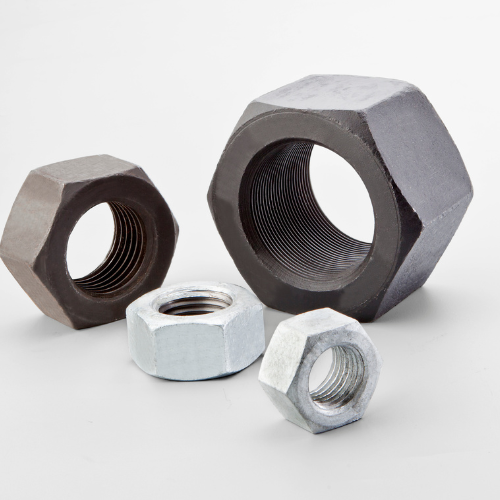
- Hot-Dip Galvanization (HDG): Essential for outdoor steel plates and bridges. Note: HDG bolts require "oversized" nuts to accommodate the thick zinc layer while maintaining thread integrity.
- Stainless Steel (A4-80): Used exclusively in marine or chemically active zones (refer to our Chemical Elements guide).
🛒 Why Source Fasteners via EYBY Marketplace?
EYBY Marketplace ensures your fasteners are never the "weak link" in your infrastructure.
- System Integrity: We sell fasteners as certified assemblies (bolt + nut + washer) to guarantee that friction and torque values meet EN 1090-2 requirements.
- Standard Mapping: Our platform automatically suggests Grade 10.9 fasteners when you add S355JR Steel Beams to your project list.
- Full Traceability: Access Mill Test Reports (MTRs) and Declarations of Performance (DoP) directly from your dashboard for project close-out.
❓ Fastener Frequently Asked Questions (FAQ)
Can I use a Grade 12.9 bolt in structural steel?
Generally, no. While stronger, Grade 12.9 bolts are more brittle and susceptible to hydrogen embrittlement. Structural standards (EN 14399) typically cap grades at 10.9 for outdoor or safety-critical construction.
What does the "SB" mark on a bolt mean?
"SB" stands for Structural Bolting under the EN 15048 standard. It signifies the assembly is tested and certified specifically for non-preloaded structural steel connections.
Why must I buy bolts and nuts in a set?
Under 2026 standards, the bolt, nut, and washer are tested as a single batch. Mixing a nut from one manufacturer with a bolt from another can change the friction coefficient, leading to dangerous over-tightening or failure.
Related Posts
Sandblasting Sand: Why the Cheapest Abrasive Costs You the Most
Types of Pliers: Jaw Shapes, Grip and What Each Pair Is For